

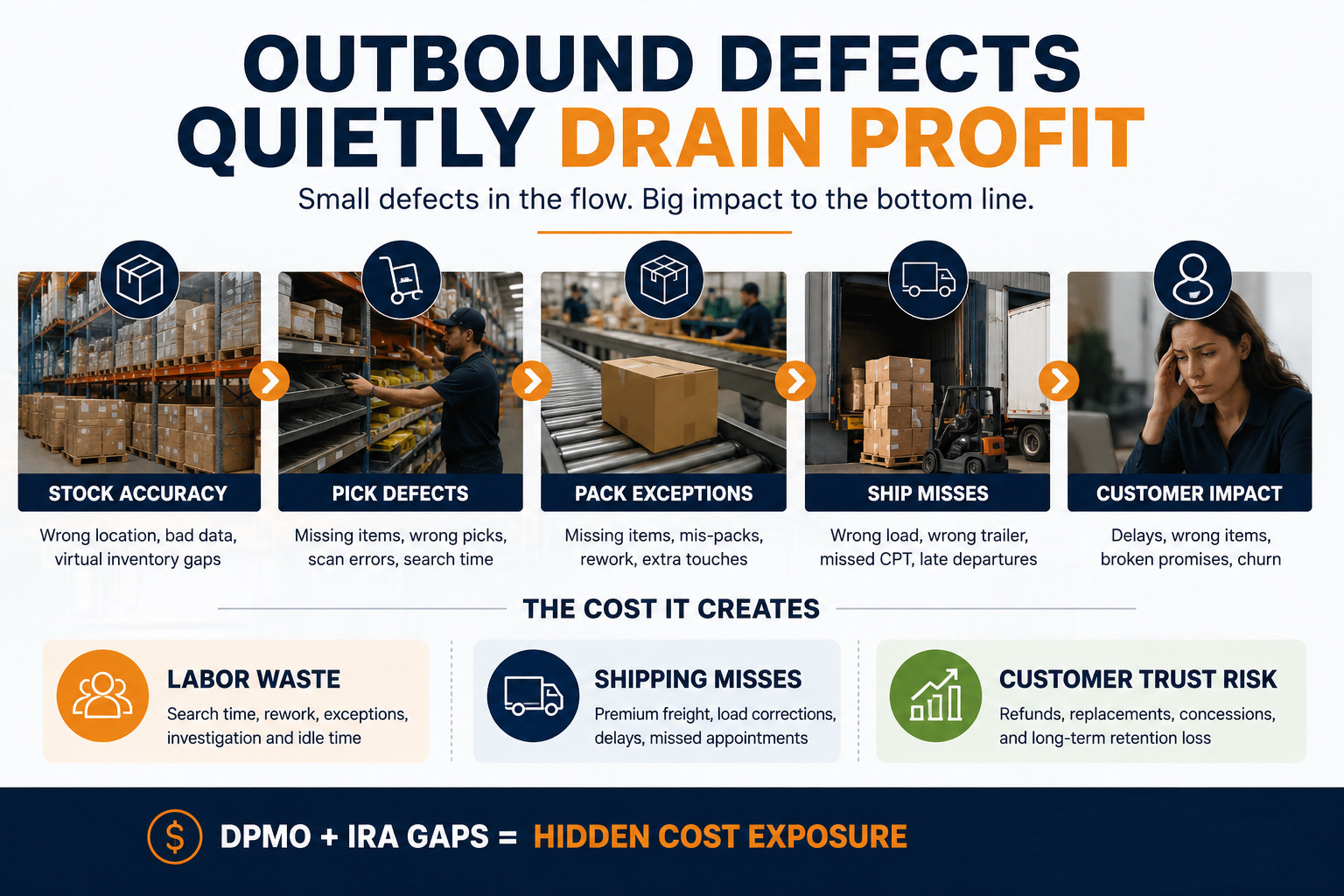
Outbound defects rarely stay inside one process path.
A poor inventory transaction in stock can become a missing item during pick. A missing item during pick can become a pack delay. A pack exception can become rework. A misplaced pallet or unit in shipping can become a missed critical pull time, a delayed trailer, premium transportation cost, or a customer promise failure.
That is why reducing outbound DPMO should not be treated as only a pick, pack, or ship issue.
It is usually an end-to-end cost issue.
DPMO means defects per million opportunities. In simple terms, it measures how often a process creates errors at scale.
IRA means inventory record accuracy. It measures whether system inventory matches physical reality.
When DPMO is high and IRA is weak, the operation pays for it in several ways:
Using rounded and anonymized figures from a large outbound operation, more than $250K in cost exposure was tied to poor inventory accuracy, missing-item defects, shipment recovery, rework, and customer-impacting failures.
The issue was not one person or one department.
It was a breakdown between physical movement, system accuracy, process visibility, and control.
Outbound DPMO is often discussed as a quality number, but the real impact shows up in cost.
The cost usually falls into three major categories.
Every missing item, wrong location, virtual mismatch, or shipment exception creates extra labor.
Teams spend time:
This is labor being paid for without creating additional customer value.
In high-volume environments, even a small recurring defect pattern can create dozens or hundreds of additional labor hours each week.
The danger is that this labor cost often becomes normalized.
Leaders may start treating rework, research, and exception handling as part of the daily rhythm instead of seeing them as symptoms of a broken process.
Late-stage defects are more expensive because most of the labor has already been spent by the time the unit reaches shipping.
If the unit is staged incorrectly, loaded into the wrong trailer, placed on the wrong pallet, or missed before departure, the operation may now need:
A defect caught at the trailer door is cheaper than a defect caught after departure.
A defect caught before critical pull time is cheaper than a defect that creates a missed customer promise.
Customer retention is harder to measure, but it matters.
A customer may forgive one delay. But repeated failed promises train the customer to buy somewhere else.
The customer does not care whether the defect started in stock, pick, pack, or ship.
They only experience the final result:
That is why outbound DPMO reduction is not just about internal efficiency. It directly connects to cost, service, and customer loyalty.
In one large fulfillment environment, the outbound defect issue was not caused by one major failure.
It was caused by several smaller gaps across the flow.
Individually, each gap looked manageable. Together, they created a system where inventory truth was constantly being challenged.
The operation was initially seeing:
The issue was not effort.
The issue was visibility, control, and process design.
Before jumping into solutions, the first question should have been:
Do we even have enough visibility to understand where the defect is starting?
That question matters because if the operation cannot clearly see where the defect starts, who touched the unit, where the physical item moved, and whether the system moved with it, then the team is not solving root cause.
It is solving a theory.
And solving the wrong theory gets expensive quickly.
It creates:
The first step was not coaching.
The first step was understanding.
Before asking who made the mistake, the operation needed to answer:
This is where many operations struggle.
They may have reports, but not visibility.
A report tells you something happened. Visibility tells you where it started, how it moved, who touched it, and what failed.
A few practical mechanisms helped create that visibility:
A Pareto view helped separate the few defects causing most of the pain from the long list of noise.
Not all defects deserve equal attention.
The goal was to identify the defect types that created the most labor waste, shipment delay, and customer impact.
Reports do not always tell the full story.
Floor observations helped validate whether the data matched the process.
This was especially important in areas where work was physically moved before the system reflected the move, or where associates had developed informal workarounds that were not visible in the data.
Associates often know where the process is breaking before dashboards do.
Feedback from pickers, packers, loaders, problem solvers, inventory control associates, and support teams helped expose friction points that leadership may not see from reports alone.
The team looked across multiple categories:
This prevented the operation from blaming one group too early.
Once the team had several possible causes, prioritization became important.
The root causes were ranked using a few simple questions:
A root cause that happens often, creates rework, affects customer experience, and can be controlled locally should move to the top of the list.
That is how the team avoided chasing low-impact defects while expensive ones kept repeating.
Inventory record accuracy is not just an inventory control metric.
It is the foundation for outbound execution.
If the system says an item is in a bin, but the item is not physically there, pickers lose time searching.
If a unit is virtually consumed but physically left unresolved, the operation creates hidden financial exposure.
If too many users can move or consume inventory virtually without clear controls, the building slowly loses inventory truth.
The key question became:
When the item physically moves, does the system move with it?
That question exposed several gaps:
The improvement focused on three areas.
High-risk virtual consumption or inventory movement actions should not be available to everyone.
The operation reduced exposure by limiting certain permissions to a smaller group of trained leaders or associates.
This did not remove flexibility. It created control.
When fewer people can perform high-risk transactions, it becomes easier to track ownership, verify process adherence, and prevent inventory truth from being damaged by uncontrolled actions.
In large operations, some areas carry more risk than others.
Examples include:
A heat map helped identify where inventory was more likely to become physically present but virtually unclear.
This allowed leaders to focus audit walks, coaching, and controls on the areas most likely to create downstream defects.
The process was mapped from end to end.
At each step, the team asked:
The goal was simple:
Stop allowing the floor and the system to tell two different stories.
Some pick defects start upstream.
A stock associate may place an item into one bin but scan a different bin.
From the picker’s perspective, the item is missing.
From the system’s perspective, the item should be there.
That creates:
Another issue is bin quality.
If a bin has too many items, or too many similar item IDs, the chance of confusion increases.
The fix was not just telling pickers to look harder.
The process needed better controls before the picker arrived.
Bin discipline matters because pick accuracy depends on the quality of upstream inventory placement.
Practical controls included:
When bin quality improves, pick search time drops and false missing defects become easier to prevent.
When a picker could not find an item in the expected bin, a controlled adjacent-bin check helped identify placement errors before the item was marked missing.
This does not mean unlimited searching.
The key is to create a controlled rule.
For example:
This helps prevent missing-item defects caused by items being physically close but virtually incorrect.
A missing item during pick is not always caused by pick.
Sometimes pick is only where the defect is discovered.
That distinction matters.
If leadership treats every missing pick as a picker issue, the real root cause may continue in stock, inventory control, or a previous handoff.
A better system connects pick defects back to the last known physical and virtual transaction.
That creates better coaching and cleaner ownership.
Packing defects can be misleading because packing often sees the problem late in the chain.
A picker may physically place an item into a cart but fail to complete the virtual scan correctly.
Or the item may be virtually picked but never physically make it into the cart.
In both cases, the packer receives a mismatch.
The system says the item should be there, but the physical container does not clearly support that.
This becomes harder with multi-item orders, where work can be mixed, buried, or difficult to verify.
One of the strongest improvements was adding better organization before work reached the pack station.
For multi-item orders, instead of sending all mixed work directly to packers, work can be sorted into smaller, clearer groups before it reaches the pack station.
This can be done using:
At first, adding an indirect role or control point can sound like adding cost.
But not all indirect labor is waste.
Some indirect labor protects flow.
If one indirect role reduces pack missing defects, searching, rework, and downstream delay, it can pay for itself quickly.
The question is not simply, “Does this role add labor?”
The better question is:
Does this role prevent more cost than it creates?
Pack missing-item defects should not disappear into a generic exception bucket.
A report should help answer:
This shifts the conversation from blame to root cause.
It also helps leaders identify whether the issue is training, process design, system behavior, or work organization.
Shipping defects are expensive because they happen late.
By the time a unit reaches the outbound dock, most of the labor has already been spent.
If that unit goes to the wrong pallet, staging area, trailer, or load, the operation may now be dealing with:
The goal in shipping is to catch defects at the lowest-cost point.
A defect caught at the trailer door is cheaper than a defect caught after departure.
For live loads, one issue was mixed staging.
Pallets were being staged before trailers arrived, but the staging logic was not always clear enough physically or virtually.
The improvement was to create:
The key was making physical staging match system staging.
If a shipment moved physically into a holding area, the system needed to reflect that move.
This reduces confusion, protects trailer accuracy, and improves ownership.
For manual fluid loading, especially in sites without advanced automated MHE, the control needed to happen as close to the trailer door as possible.
Not every site has the budget to invest millions of dollars into automated five-sided scanning systems, high-end sortation, or advanced material handling equipment.
Those systems can be valuable, but smaller-budget sites still need practical controls.
One practical control is to create a scan-based defect point at the trailer door.
If a loader scans a unit into a trailer where it does not belong:
This creates cleaner ownership.
If the loader catches the issue before departure, the defect is contained early.
If the wrong item is discovered downstream, the team can trace back to the last responsible handoff.
The purpose is not to punish every mistake.
The purpose is to make the defect visible early enough to prevent expensive failure.
A key lesson from this work is that DPMO reduction does not always require a major automation project.
Automation can help, especially when volume, complexity, and capital justify the investment.
But many facilities do not have millions of dollars available for automated scanning, sortation, or advanced MHE.
That does not mean they are stuck.
Smaller-budget sites can still reduce outbound defects by focusing on practical operating controls:
These solutions are not always flashy.
But they are practical.
And in many operations, practical controls create more near-term value than waiting for a future automation project.
After the improvement work, the operation moved closer to:
The cost impact showed up across three areas.
Less time was spent searching, escalating, sorting through exceptions, and reprocessing work.
Instead of constantly reacting to defects, leaders had better visibility into where defects were starting and how to prevent them earlier.
Fewer late-stage defects helped improve trailer accuracy, reduce missed loads, and lower the need for recovery actions.
The operation became better at catching issues before they became expensive transportation problems.
Fewer broken promises meant fewer delayed or incorrect orders reaching the customer.
That matters because customer trust is built through consistency.
The biggest win was not just the metric improvement.
It was the improvement in operating clarity.
The team had a better understanding of where defects started, how they moved, and what controls were needed to stop them earlier.
Outbound DPMO is not just a quality metric.
It is a cost metric, a flow metric, an inventory-truth metric, and in many cases, a leadership visibility metric.
The strongest outbound operations do not just move fast.
They protect inventory truth while moving fast.
That does not always require a multimillion-dollar automation project.
Sometimes the biggest unlock comes from:
Because once the system and the floor stop telling two different stories, the operation can finally improve with confidence.
At QuayDot, we help operators identify hidden cost leaks between process design, system visibility, labor execution, inventory accuracy, and customer impact.
For warehouses, fulfillment centers, and 3PLs dealing with recurring defects, poor inventory accuracy, missed loads, or excessive rework, the answer is not always more labor or bigger automation spend.
Often, the first step is understanding where the process is breaking and building practical controls that protect flow.
QuayDot can help with:
Most buildings do not need more noise.
They need cleaner visibility, tighter controls, and practical mechanisms that show where the work is breaking before the customer feels it.
If your operation is dealing with outbound defects, inventory accuracy issues, missed loads, or recurring rework, QuayDot can help identify the root causes and build practical controls before the cost keeps compounding.
