

A high-volume warehouse operation faced a growing inbound backlog of over 150,000 units across 200+ trailers, creating risk of yard congestion, trailer shortages, and operational disruption ahead of peak.
Although the initiative had been underway for several weeks, progress remained inconsistent. Execution varied by shift, throughput was unstable, and there was no standardized model driving performance.
The objective was to improve warehouse process efficiency, eliminate bottlenecks, and increase throughput—without relying on additional labor.
This was not a labor shortage issue.
It was a workflow optimization and labor allocation problem driven by how the operation was structured.
Key challenges included:
As inbound throughput increased, the downstream storage function became a hidden constraint, threatening to slow the entire operation and create additional handling inefficiencies.
The focus was to redesign execution into a single, scalable operating model that could run consistently across shifts—without constant oversight.
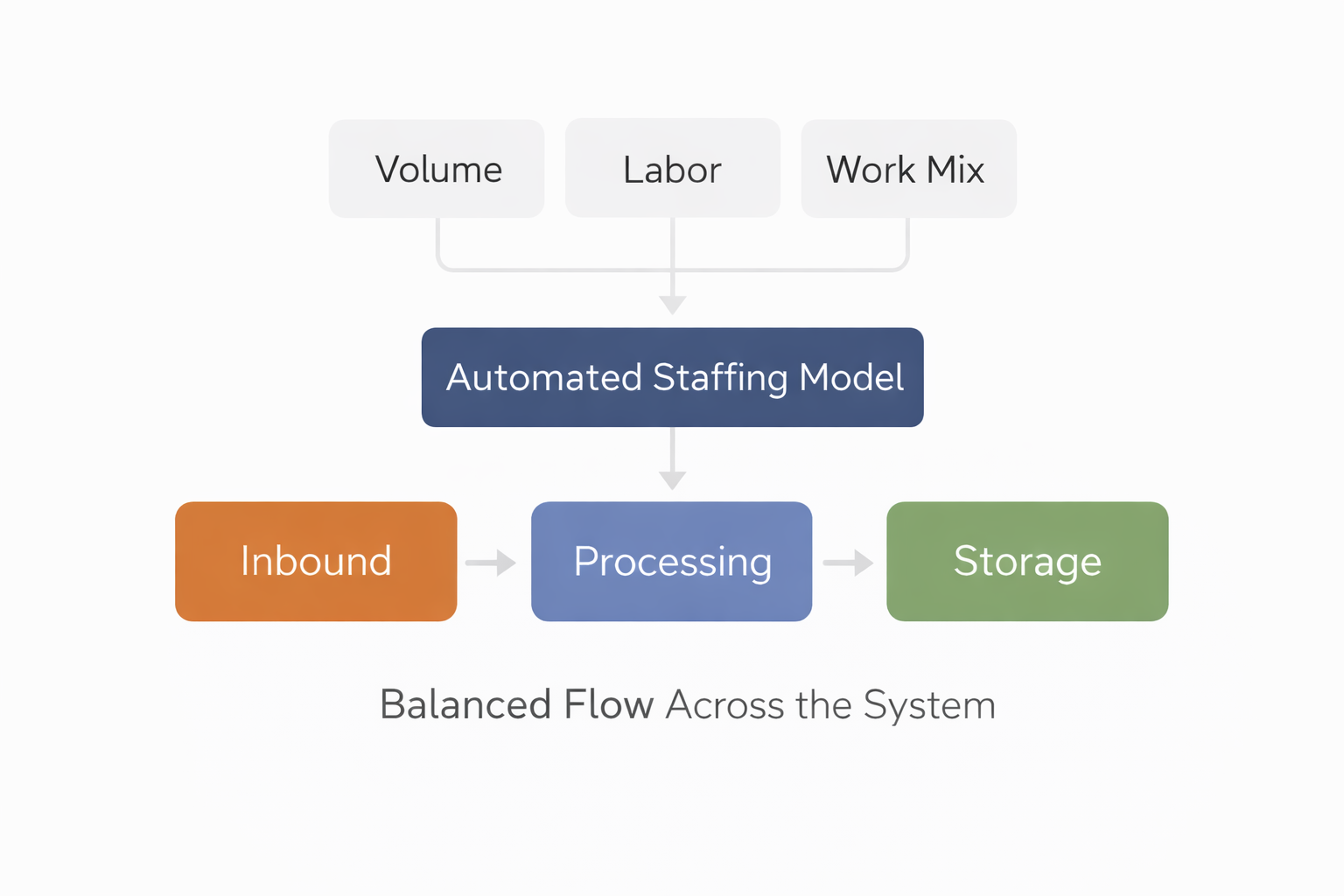
Instead of relying on shift-level judgment, a simple automated staffing model was developed using time studies and workflow variables.
The model was structured around throughput demand and capacity across direct and indirect functions, including:
Rather than treating bottlenecks as isolated issues, end-to-end flow alignment was built directly into the staffing logic—ensuring labor allocation matched the capacity of each function across the system.
This ensured that increases in inbound throughput were sustainably absorbed by downstream capacity, preventing congestion and maintaining continuous flow.
This:
Early-shift inefficiencies were caused by inconsistent preparation of tools and equipment.
Startup readiness was standardized by ensuring all required tools (scanners, carts, pallet jacks) and supplies were consistently staged and ready.
This resulted in:
As throughput improved, downstream storage became the next limiting factor.
To prevent this from slowing the system:
This improved visibility allowed teams to quickly identify open space, reduce search time, and maintain flow without creating new bottlenecks.
The operation initially functioned as separate efforts by each shift, with limited consistency in how performance was managed.
To address this, clear KPIs were established and tied directly to key bottlenecks and performance drivers across the workflow.
This:
Combined with improved cross-shift communication, this transformed execution into a coordinated, performance-driven system.
Throughput: ~1200 → ~1800/day
Staffing: Manual → Automated & flow-aligned
Workflow: Inconsistent across shifts → Standardized across shifts
Bottlenecks: Frequent → Controlled
This project succeeded because it focused on system design rather than effort.
Key drivers:
The result was a sustainable increase in operational efficiency, not a temporary performance spike.
This approach is directly applicable to:
Especially those experiencing:
At QuayDot, the focus is on identifying where operational flow breaks and building simple, practical systems that improve efficiency and scalability.
If your operation is experiencing bottlenecks, backlog, or inconsistent throughput, there are often opportunities to improve performance without increasing complexity.
