
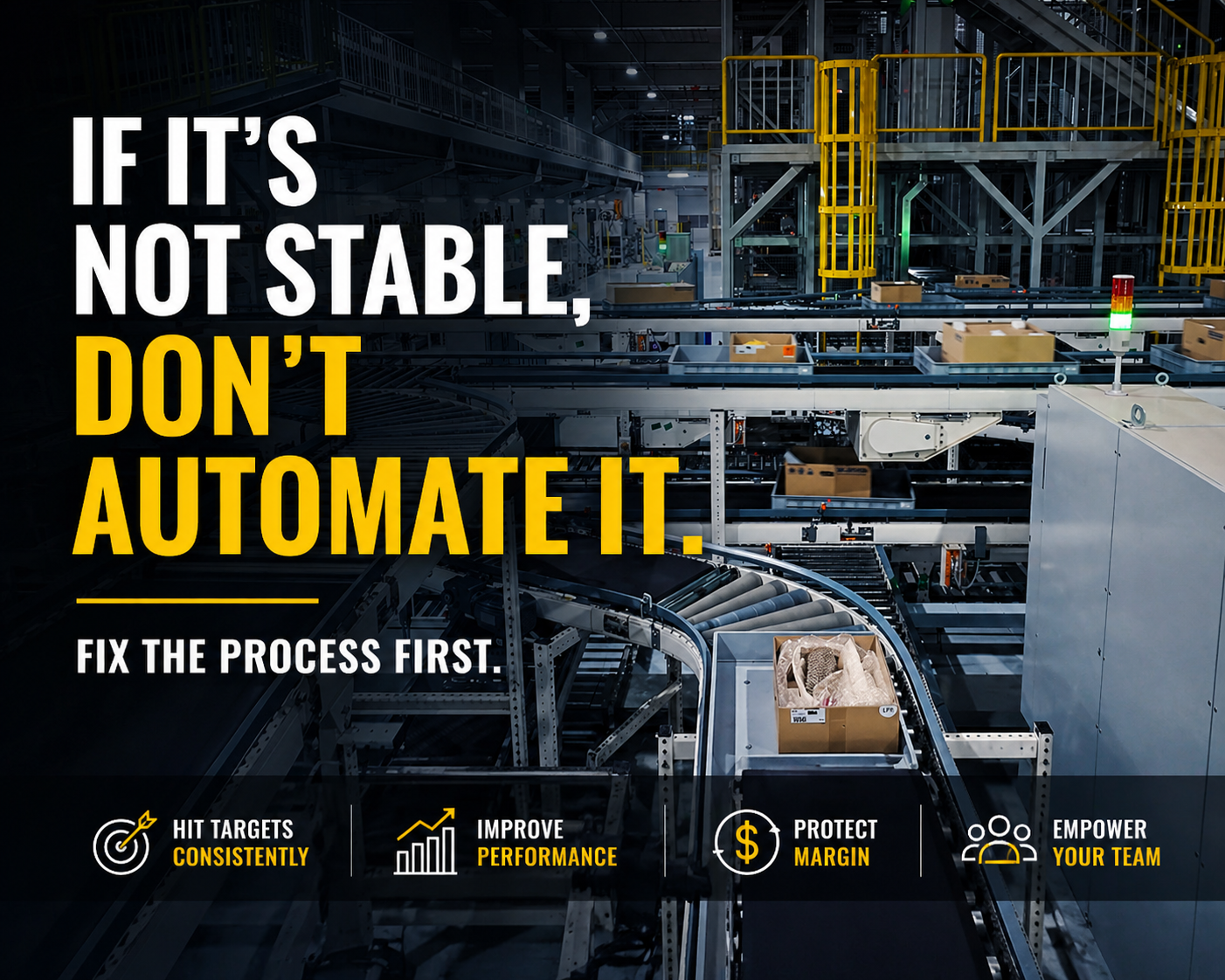
Warehouse automation is one of the biggest conversations in supply chain and logistics right now.
Warehouses, fulfillment centers, and 3PL operations are looking for ways to move faster, reduce manual work, improve visibility, and lower operating costs. That usually leads to conversations around dashboards, workflow automation, AI tools, reporting systems, integrations, and warehouse management technology.
And to be clear, automation can create major value.
But only when it is applied to the right process.
One of the biggest mistakes operations teams make is trying to automate a process that is not stable, not consistent, or not designed to hit its targets.
When that happens, automation does not fix the operation.
It exposes the weakness.
And in some cases, it makes the problem move faster.
Before a warehouse automates a workflow, leadership should ask a simple question:
Can this process consistently deliver the result we expect?
If the answer is no, automation should not be the first move.
A process that misses targets, changes by shift, relies on workarounds, or depends on top performers to save the day is not ready to be scaled. It needs to be improved first.
Common signs that a warehouse process is not ready for automation include:
These are not automation problems.
They are process design problems.
If the process is unstable, automation can make it harder to see what is actually happening. Instead of solving the root cause, the business may end up automating confusion.
The best warehouse automation strategies do not start with software.
They start with understanding how the work actually flows.
Before automating, operations teams should look at:
This step matters because automation works best when the process is already clear, repeatable, and measurable.
If the workflow is messy, the technology will not magically clean it up.
A dashboard will not fix unclear ownership.
An alert will not fix a broken handoff.
A bot will not fix inconsistent process standards.
An integration will not fix poor data quality.
The process has to be designed to perform first.
Then automation can help scale that performance.
The best automation opportunities are usually not the most complicated processes.
They are the repetitive, predictable, low-value tasks that take time away from the team.
Examples include:
These tasks are necessary, but they do not always need to be done manually.
When automated correctly, they free leaders and associates to focus on work that actually improves the operation.
That includes fixing bottlenecks, reducing defects, improving flow, protecting margin, and solving the issues that keep coming back.
This is where automation creates real leverage.
Not by replacing the team.
But by giving the team more time to improve the system.
A strong automation strategy should make a good process easier to manage.
It should help the operation:
But automation should not be used to cover up a weak process.
If a warehouse is constantly firefighting, struggling with inconsistent output, or missing performance targets, the first priority should be process improvement.
Automation is not the starting point.
Automation is the multiplier.
If the process is weak, automation multiplies the weakness.
If the process is stable, automation multiplies the performance.
For 3PLs, this is even more important.
A 3PL does not just need to run the operation. It also needs to explain performance to customers.
That means visibility matters.
When a client asks why orders were delayed, why inventory was inaccurate, why returns are backing up, or why service levels dropped, the answer cannot be based on guesses.
The operation needs clean process visibility.
It needs to know what happened, where it happened, when it happened, and what caused it.
That level of control is hard to build if the process is unstable.
It is even harder if the team tries to automate before understanding the process.
For 3PLs, process improvement and automation should work together.
Process improvement creates control.
Automation creates speed.
Together, they create scalable performance.
The strongest warehouse operations do not choose between process improvement and automation.
They use both.
But the order matters.
First, improve the process.
Then automate the repetitive parts that are ready to scale.
A practical approach looks like this:
This approach prevents teams from wasting money on tools that do not solve the real problem.
It also helps automation deliver measurable value instead of becoming another system the team has to manage.
Warehouse automation is powerful.
But it is not magic.
It works best when the process is already designed to perform.
If a process cannot consistently hit its targets, automation will not fix it. It will only move the problem faster.
The real opportunity for warehouses, fulfillment centers, and 3PL operations is not simply adding more technology.
It is building better processes first.
Then using automation to reduce manual work, improve visibility, and scale what already works.
Most operations do not need more tools before they understand the process.
They need a process that can perform.
Then they need the right automation to amplify it.
At Quaydot, we help warehouse and logistics teams improve process flow, identify operational gaps, and automate repetitive work that slows the team down.
If your team is spending too much time chasing reports, fixing recurring issues, or relying on manual workarounds, the first step may not be another tool.
It may be a clearer process.
And once the process is stable, the right automation can help scale it.

